It has been at least three years since my last post; the time has flown by. In that time, there have been more adventures than I would ever attempt to summarize; but one element has been true all along: God is the orchestrator of things beyond my ability to comprehend. The more I come to terms with that truth, the more I am aware of His presence, even in the dark moments that seek to tear us down. The best way to build that awareness is to take the time to reflect on where you’ve been, where you are and where you perceive you are going.
So sail yourself into a quiet cove, drop the anchor and chill for a bit. You might be surprised what you learn.
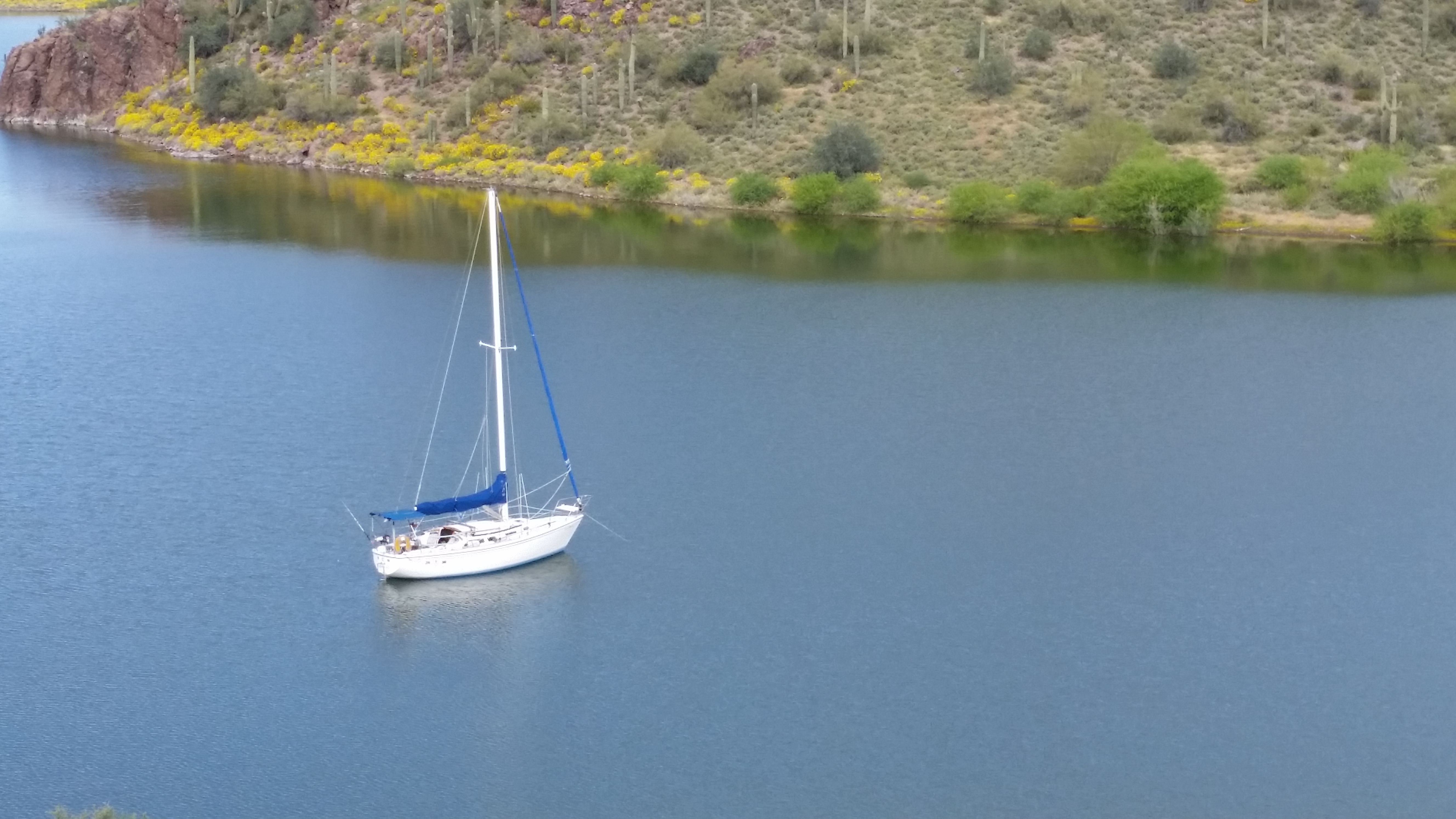
ZigZag (one day to be renamed the Sparrow) at anchor in Rock Island Cove, Lake Pleasant, AZ.
Seek in reading and thou shalt find in meditation; knock in prayer and it shall be opened in contemplation.~John of the Cross
We live, in fact, in a world starved for solitude, silence, and private: and therefore starved for meditation and true friendship.~C.S. Lewis
At some level, I suspect that most people will acknowledge that meditation is a good thing, but when we are in the thick of our daily routine we suddenly view it as a waste of time. I am every bit as guilty of this as anyone. I can sit down and pen a detailed discussion of the spiritual benefits of prayer and meditation, but I rarely actually practice meditating for more than a few days at a time. The link below is from ASAP Science and might offer some motivation for all of us (regardless of your faith tradition).
Resilience – the ability to become strong, health or successful again after something bad has happened
There is a story of a visitor to a Benedictine monastery that asked one of the monks what it was like to be a Benedictine. The monk responded, “Well, we fall down and we get up. Then we fall down and we get up. Then we fall down…” The monk was acknowledging that sin was an unavoidable condition, but that in faith God gives us the strength to recover and continue moving forward. We all experience stress or suffer events that have the capacity to knock us down. The question is whether or not we stand back up. For the last week and continuing this week, I am in a course that will prepare me to teach how to be resilient. The goal is to help others learn that resilience is not an inherent condition but a choice to think about life in a new way. The attitudes we hold close can be our strength or our liability. We need to make the choice of what attitudes guide us before we find ourselves confronted by the challenges of life.
The link below is of the Hoyt family. When they were faced with the challenge of having a son with severe disabilities, they chose a positive perspective. It could not have been easy, but there is no doubt of the reward. By the way…the idea to start racing was the son’s…
In the event that anyone discovers these posts and wonders, let me make a confession. I did not start this blog as the result of some deep seated desire to express myself. In fact, while I had thought about blogging a couple of times over the years, I never would have started were it not that I am in a class that requires it. That’s right, this blog was a requirement if I wanted to pass a class. Now, presumably, this requirement had a learning goal. So you might then asked the obvious question: “Bill, what have you learned?” Here what I’ve got so far:
Blogging is not nearly as difficult as I imagined it to be.
It really is a great way to share thoughts and reflections to someone other than my wife.
The process of formulating a thought that can be read by anyone forces you to go deeper than you might have otherwise.
And while the art of blogging might one day pass, it is still a great way to bring people together around an idea (whatever that idea might be).
So am I glad that I started this blog? Yes. Now that I have reached the course requirement of five posts, will I continue to blog? I suspect so; come back later and find out.
Today I found myself meditating on 1 Peter 4:8: “Above all, maintain constant love for one another, for love covers a multitude of sins.” This was the first verse I was ever encouraged to memorize and it has always served as a gentle reminder that at the center of the Gospel is an act of love that covers all of our sins. The simple truth is that I will sin. It is love for others that leads me to confess those sins and try to remedy the damage that I do.
I once read a legend (totally unverified) about the Apostle John that said he had eventually been freed from his exile and, as an aged man, was once again part of a Christian community. The story continued by saying that the faithful would gather for worship and John would be brought in on a chair, because he was too old to walk. He would remain silent through the worship, but at the end he would be invited to speak (he was the last living apostle after all). He would raise his head and say as clearly as he could: “Love”. That is all he would ever say at these gatherings. One day, a student in the community asked him plaining: “You are the last of the apostles and had direct contact with our Lord. There is so much you could teach us, but all you say is ‘Love’?” John looked the young student in the eye, smiled and said, “That’s all that matters”.
An attribute of great literature is the transformation of the characters as the story progresses. Harry Potter went from living under the stairs to saving the world; Frodo Baggins from naïve boy to hardened soul; Beatrice Prior, the plain girl from Abnegation to Tris the Dauntless heroin that sacrifices her life. Each of these stories draw readers (in part) because their characters grow and mature in a manner that invites us to join them. The Bible is no different.
Sometime we imagine that the disciples were miraculously transformed at the moment of Pentecost: going from whiny and scared to bold and selfless with a single breathe from God. That might not be the case. In Acts, Peter’s first sermon as an Apostle is addressed to the “Men of Israel…” (Acts 2:22). His discourse focuses on that audience and so does his ministry. In fact, we learn that Peter’s emphasis on the Jews gives rise to the first major conflict within the early Church (see Galatians 2:11-14). God, however, intervenes. In Acts 10, Peter has a vision that challenges his assumptions of what is and is not clean in God’s eyes. The result is his proclamation, “Truly I understand that God shows no partiality, but in every nation anyone who fears him and does what is right is acceptable to him…” (Acts 10:34-35). Peter assumptions were totally transformed.
Too often we imagine that we have the world figured out and that we know right from wrong, good from evil. We blissfully go through life proclaiming what we believe, only to have God role in and turn everything upside-down in a single stroke. As people of the Way, we can be confident in God’s love, Christ’s sacrifice and the Spirit’s presence. Outside of that…proceed with caution.
The Gospel text assigned for this Sunday recalls the call of Philip and Nathanael (John 1:43-51). There’s a lot going on in this text, but most of it is a mystery to us as the reader. This leaves all sorts of room for us to speculate; albeit without a leg to stand on. That said, there is one element of the passage that seems clear: the initial call of the disciples was by way of direct and personal encounters. Jesus did not post a casting call or print a classified ad calling for resumes. Jesus engaged the disciples as individuals. In the case of Philip, Jesus went out and found him. For Nathanael, Philip went out and found and brought him to Jesus. Now, Philip did not make Nathanael a disciple. He did, however, facilitate the introduction.
It seems that Philip and Nathanael each illustrate the two most common ways in which we become followers of Jesus. For some of us, Jesus engages our lives unexpectedly and we are transformed by that encounter. For others, we are invited by another. We might be skeptical, but if we arrive with and open mind we might be surprised to find that Jesus was already expecting us.
As a new Christian, I was given some advice: whenever you feel like you’ve lost your connection to God, go back to the last place you were together…physically. I liked the idea, but I could imagine there being a challenge if the physical location was no longer accessible (say a mountaintop in another state). So I made a deal with God: If ever I felt like we were separated, we would rendezvous at the Memorial Garden at St. Barnabas Church in Scottsdale, Arizona. This was a prayerful place for me that was accessible, but inconvenient enough that I would have to be serious about the task. Over the years, I have sought renewal in that place only twice. Those seemed like desperate moments in my life and I am glad God and I had this “arrangement”.
When considering the events recorded in John 4, we realize that my idea of a rendezvous point is not necessary. God meets us where we are and approaches us with a grace formulated just for us, in only the way our personal creator can. The real challenge is to be aware of the meeting when it happens. The woman at the well did not arrive there with any expectation of a life changing experience, but that is exactly what God had in mind for her. As we all go through the motions of our daily routine, know this: Nothing separates us from the love of God in Christ Jesus our Lord (Romans 8:37-39). Keep your eyes open the next time you go to your well.